
Home / Research & Analysis / Commentary Paper
The Great Reset: Transforming the Office of Thailand Trade Representatives
Based on information provided by UNCTAD and major investment monitors, its is estimated that, in 2026, the value of global FDI will be at around USD 1.75 trillion. From this amount, an estimated 15% to 16%, or an estimated USD 275 billion, is expect to come to Southeast Asia. This is the “pot” of FDI from which Thailand must compete with its neighbors to win over the hearts and minds of investors.
At the same time, based on UNCTAD and WTO projections, the value of global trade for 2026 is estimated at USD 33 trillion. From this amount, it is expected that roughly 12%, or USD 4.1 trillion, is likely to come from Southeast Asian countries.
Against this backdrop, it is clear that Thailand is in need of a highly efficient trade and investment promotion apparatus to sustain its continued economic growth in an increasingly competitive and volatile global economic landscape.
At the forefront of this effort is the Office of the Thailand Trade Representatives (OTTR), which reports directly to the Prime Minister. In order for the country to remain competitive in international trade and investment, there needs to be a “reset” of the OTTR and the body must operate as a high-agility, efficient and results oriented “strike team” for the Prime Minister.
Below is a proposed framework for the roles, structure, and accountability of a four person TTR team, designed to integrate seamlessly with Thailand’s existing economic ministries.
1. Role and Core Responsibilities
The TTR is not a traditional diplomat; they are a Special Envoy and “Deal-Maker” with the rank of Minister. Their primary purpose is to bypass bureaucratic silos to secure high-value economic wins.
The primary role and responsibility of a TTR should include:
- Proactive Investment Hunting: Identifying and “closing” investments from “Tier 1” global corporations (e.g., AI infrastructure, semiconductors, EV batteries).
- High-Level Negotiation: Handling trade barriers or “Early Harvest” agreements that require a direct line to the Prime Minister’s authority.
- Economic Diplomacy: Representing the Prime Minister in international forums (e.g. OECD, APEC, ASEAN) to signal Thailand’s policy direction at a political level.
- Regulatory Troubleshooting: Identifying and addressing “pain points” for foreign investors and coordinating with the Economic Cabinet to streamline laws, regulations, incentives and application approval time.
2. Proposed Structure and Assignments
The OTTR should appoint one TTR to be the Chair of OTTR and supported by a shared team headed by the OTTR office manager and a number of competent staff members. No TTR should be allowed to work in isolation or as an independent agent.
Regular “update and calibration” monthly meetings should be organized and chaired by the Chair of OTTR.
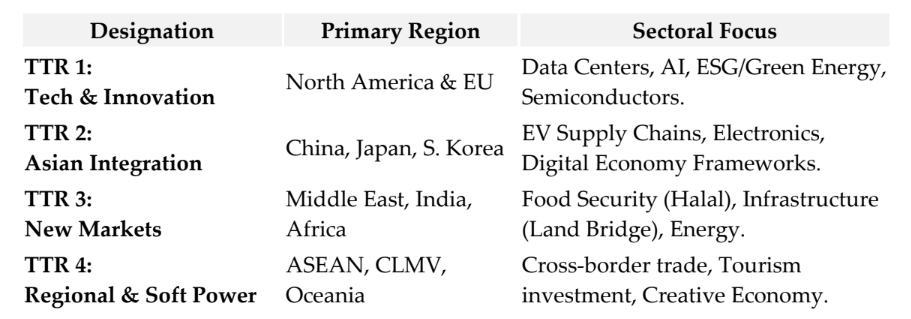
With a team of four TTRs, the most efficient structure is a Hybrid Geographic Sectoral Model. This prevents overlap and duplication and creates clear “ownership.” The proposed role and responsibility structure of the TTRs may be as follows:
3. The Work Plan and Approval Process
The Chain of Command for the Work Plan and Approval Process for the function of the OTTR and TTRs should be as follows:
- Individual Draft: Each TTR drafts a 12-month mission-specific plan.
- Harmonization: The OTTR Secretariat compiles these into an Overall OTTR Master Plan.
- Cabinet Consultation: The plan is reviewed by the Economic Cabinet to ensure it aligns with the Ministry of Commerce’s trade targets and the Ministry of Foreign Affairs’ economic diplomacy stance.
- Prime Minister Approval: The PM gives the final “Go” signal. No work should commence without this to ensure “Team Thailand” is unified.
- Approval of the Budget: for OTTR and each TTR would be based on their 12- month mission-specific plan and target of achievements.
4. Components of the Work Plan:
Clear objectives of the OTTR and each individual TTR would serve as the basis for the strategy, annual work plan, budget plan, achievement targets and measurements of the OTTR and its members. Therefore, the annual work plan may include components such as:
- The “Top 20” Target: A specific list of countries and companies to be engaged with.
- The Quantitative Goal: Specific USD value for targeted annual investment or export growth.
- Policy Gaps: Identification of which domestic regulations need to be changed in order to secure such business investment deals.
- Budget & Resource Allocation: A breakdown of how the overall budget will be used for specific missions and negotiations.
5. Measurement of Success (Key Performance Indicators - KPIs)
To ensure tangible results, success must be measured through a Tiered KPI System:
A. Common Measurement Criteria (The "North Star" Metrics)
- Actual Investment Inflow: BOI applications filed by companies directly engaged by the TTR.
- Trade Barrier Reduction: Successful removal of specific non-tariff barriers (NTBs) in the assigned region.
- Pipeline Value: The total value of “active leads” being negotiated (measured via a CRM-style system).
B. Tangible Milestones
Clear, tangible and quantitatively measurable accomplishments of the TTRs should be established at the very outset, in order to ensure that the TTRs are not positioning themselves as “world travelers,” but rather as “result oriented business negotiators.”
- Month 3: Completion of all high-level introductory missions and submission of “Diagnostic Reports” on market barriers. Set clear measurable objectives and deliverables for each of the missions.
- Month 6: Signing of at least two Memorandum of Understanding (MOU) or Letters of Intent (LOIs) with “Tier 1” global players.
- Month 12: Conversion of at least 30% of MOUs and LOIs into formal investment applications or signed trade contracts.
6. Working Relationships: The "Team Thailand" Matrix
Since the OTTR reports directly to the Prime Minister, there is a risk of friction with established ministries and other relevant government agencies. This must be managed via a Matrix Relationship:
- Vis-a-vis the Economic Cabinet: The OTTR acts as the “Implementing Arm” of the Cabinet’s policies. They provide real-time feedback from the ground to the Cabinet on which policies are failing to attract investors.
- Vis-a-vis the Ministry of Commerce (MOC): The MOC handles the “Broad Net” (mass exports, SMEs, WTO and FTA negotiations). The TTR handles the “Spear” (targeted, high-value, specific corporate deals).
- Vis-a-vis the Ministry of Foreign Affairs (MFA): The MFA provides the “Diplomatic Infrastructure and Mechanisms” (e.g., embassies, protocol, economic and market information, identify key persons and decision makers). The TTR uses this infrastructure but operates with a commercial mandate, allowing the Ambassador to remain committed to bilateral relations between Thailand and the host country and key personalities, while the TTR plays the “aggressive negotiator.”
- Vis-à-vis the Board of Investment (BOI): The TTR acts as the “Lead Hunter” who identifies and secures commitments from Tier 1 global corporations, while the BOI serves as the “Fulfillment Center” that processes applications, manages incentives, and facilitates the actual landing of the investment.
- Vis-à-vis Eastern Economic Corridor Office (EECO): The TTR functions as the “Global Salesperson” specifically for Thailand’s strategic sectors (such as data centers and semiconductors), while the EECO provides the “Specialized Infrastructure” and regulatory sandboxes where those high-value industrial deals are physically situated and operationalized.
As a way of work, the OTTR should secure monthly “Economic Intelligence Exchange” meetings chaired by the PM or Deputy Prime Minister in charge of economic affairs, attended by all four TTRs and the Ministers of Commerce and Foreign Affairs, head of the Board of Investment and head of the Office of Eastern Economic Corridor, to ensure that everybody works as one team in the spirit of cooperation, data is transparently shared across silos, and that there will be no overlapping, no duplication of work, and no one is “stepping on the toes” of anyone.
Aside from regular meetings at the Cabinet level, OTTR should also organize at least quarterly meetings with the business communities in Thailand, such as the Joint Standing Committee on Commerce, Industry and Banking (JSCCIB) and Foreign Trade chambers, to seek their advice and other useful information.
It would be counter-productive to allow TTRs to operate and travel as free agents, without clear targets, expected deliverables and systematic coordination with OTTR, the Prime Minister and other stakeholders within the government and the local business communities.
7. Conclusion: Elite Strategic Trade Negotiators
The ultimate success of Thailand’s proactive economic agenda hinges on an OTTR that functions as an efficient “strike team,” a high-precision instrument of statecraft rather than a traditional administrative body. By operating in a seamless, transparent, and integrated manner with the Economic Cabinet and key ministries, the TTRs can transform themselves from “busy world travelers” into elite strategic trade negotiators who treat every international mission as a targeted investment operation. This shift toward a results-oriented culture—where every baht of the public budget is anchored — to tangible, quantifiable, and objective milestones, would help ensure that economic and trade diplomacy is no longer measured by the frequency of travel, but by the concrete realization of high-value investments and the measurable expansion of Thailand’s share of trade in the global market.
ON THIS PAGE
- 1. Role and Core Responsibilities
- 2. Proposed Structure and Assignments
- 3. The Work Plan and Approval Process
- 4. Components of the Work Plan
- 5. Measurement of Success (Key Performance Indicators - KPIs)
- 6. Working Relationships: The "Team Thailand" Matrix
- 7. Conclusion: Elite Strategic Trade Negotiators
ON THIS PAGE
- 1. Role and Core Responsibilities
- 2. Proposed Structure and Assignments
- 3. The Work Plan and Approval Process
- 4. Components of the Work Plan
- 5. Measurement of Success (Key Performance Indicators - KPIs)
- 6. Working Relationships: The "Team Thailand" Matrix
- 7. Conclusion: Elite Strategic Trade Negotiators
Further Reading
- Analysis