
Home / Research & Analysis / Policy Brief
No. 5/2026 · 5 June 2026
From Assembly Lines
to Advanced Architectures
A Blueprint for the Development of
Thailand’s Semiconductor Workforce and Ecosystem
Darmp Sukontasap, Ph.D.
Abstract
As global supply chains reconfigure around technological sovereignty and resilience, Thailand stands at a critical juncture. Historically centered on downstream, legacy back-end assembly and testing, the nation has launched a transformative mandate: the “MHESI for Semiconductor” policy, which aims to develop 80,000 highly skilled advanced electronics and IT/AI professionals by 20301 . This paper examines the human resource development (HRD) models of the East Asian semiconductor powerhouses—Mainland China, Taiwan, Japan, and South Korea—to extract actionable strategies for Thailand. Led by the Ministry of Higher Education, Science, Research and Innovation (MHESI), Thailand must pivot toward upstream high- value activities, including Integrated Circuit (IC) design, power electronics, and advanced packaging. This research outlines a comprehensive, structured blueprint to transform Thailand into a regional manufacturing and R&D hub through educational sandbox restructuring, national training centers, and targeted ecosystem clusters.
Introduction
For over four decades, Thailand’s electrical and electronics (E&E) sector has driven national export volumes, yet it has remained largely confined to low-margin assembly, packaging, and testing2. In the contemporary geopolitical landscape, characterized by localized supply chain re-shoring, this legacy model faces structural stagnation. To evade the middle-income trap, Thailand must transition toward an innovation-driven economy.
MHESI’s ambitious initiative to cultivate an 80,000-strong advanced technology workforce between 2026 and 2030 represents a major policy shift. However, a sudden influx of public funding is insufficient to build a world-class semiconductor ecosystem. Success requires a deeply coordinated human capital strategy. By mapping the developmental pathways of East Asia’s microchip pioneers, Thailand can implement a rigorous, systemic framework for workforce development and industrial growth.
1. Comparative Analysis of East Asian Semiconductor HRD Models
The ascension of Mainland China, Taiwan, Japan, and South Korea within the global semiconductor hierarchy was not accidental; it was orchestrated through specialized, state-backed human resource development frameworks.
Taiwan: The Co-Education and Academic Integration Paradigm
Taiwan’s global dominance in wafer fabrication is anchored by its hyper-aligned university-industry pipeline. Confronting a severe talent deficit in the late 20th century, the Taiwanese government established specialized semiconductor research institutes at top universities, such as National Tsing Hua University and National Yang Ming Chiao Tung University3. These institutes are co-funded and co-managed by industrial giants like TSMC and UMC. This framework ensures that academic research truly reflects the current engineering challenges faced by manufacturers. In this way, university lecture halls are transformed into practical problem-solving laboratories.
South Korea: Chaebol-Driven Specialized Track Programs
South Korea’s dominance in memory chip architectures relies on corporate-academic contracts known as Gyeoyak Hakgwa (Contract Departments)4. Corporations like Samsung Electronics and SK Hynix directly finance bespoke undergraduate and graduate departments at elite universities. Curriculum design is dictated by corporate R&D roadmaps, and students are guaranteed employment upon graduation. This model minimizes entry-level training friction and aligns student skills with industry specifications.
Mainland China: The Broad-Scale State Mandate and National IC Schools
To achieve tech self-reliance, Mainland China implemented a centralized institutional model. The Ministry of Education designated elite universities as “National Exemplary Schools of Microelectronics“5. Supported by heavy state subsidies, these programs scaled up the domestic engineering talent pool rapidly. This massive academic pipeline operates alongside the “Thousand Talents” initiative, which aggressively recruits high-level foreign experts and diaspora scientists to bridge the domestic R&D experience gap.
Japan: Consortia-Led Reskilling and Ecosystem Revitalization
Following the decline of its consumer electronics manufacturing dominance, Japan transitioned its focus to semiconductor manufacturing equipment, silicon wafers, and specialized power electronics6. Japan’s HRD strategy relies on collaborative public-private consortia, such as the Leading-edge Semiconductor Technology Center (LSTC). This model focuses on cross-disciplinary upskilling, retraining legacy automotive and industrial engineers in advanced power devices (Silicon Carbide and Gallium Nitride architectures), and integrating institutional research with industrial tooling vendors.
2. Structural Bottlenecks in Thailand’s Technological Labor Supply
Despite producing a high volume of engineering and technical graduates annually, Thailand faces deep structural misalignments that threaten its semiconductor ambitions:
- The Competency Chasm: While the raw volume of bachelor’s degree holders in engineering is sufficient, traditional curricula remain decoupled from advanced semiconductor manufacturing. Graduates are often trained in broad electrical concepts rather than microelectronics, quantum mechanics, or sub-micron lithography process steps7
- Graduate Scarcity in Advanced Degrees: There is an acute shortage of domestic candidates pursuing Master’s and Doctoral degrees in solid-state physics, materials science, and electronic design automation (EDA). This deficit severely limits Thailand’s capacity to engage in original front-end R&D.
- Absence of Shared Infrastructure: Small and medium universities lack the massive capital required to construct and maintain ISO-certified cleanrooms and purchase EDA software licenses. This resource deficit limits practical, hands-on training to only a few elite and privileged urban centers.
3. A Strategic Roadmap for Thailand's Workforce Transformation
To effectively deploy its allocated budget and hit the 80,000-personnel target, MHESI should execute a phased, multi-tiered structural reform based on East Asian best practices.
Figure 1: Structural Reform Model for Thailand's IT Workforce Transformation
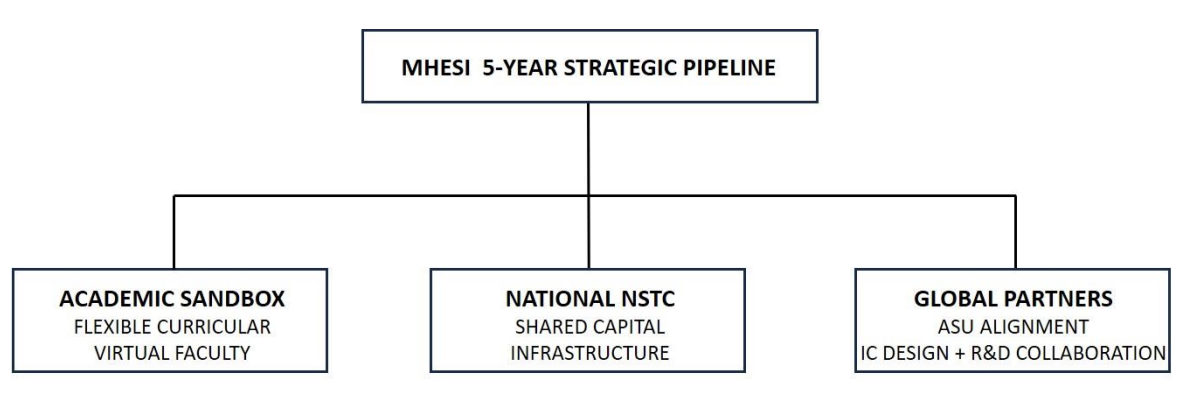
Strategic Action 1: Institutional Restructuring via Educational Sandboxes
MHESI must utilize its regulatory “Higher Education Sandbox” mechanism to bypass rigid, outdated bureaucratic processes8. This reform should be operationalized through two core initiatives:
- The Virtual Faculty Framework: A centralized network designed to pool microelectronics professors and industry lecturers across various universities. This platform will deliver specialized courses via a unified digital architecture, ensuring high-quality instruction reaches regional institutes9
- Semi-Custom Degree Integration: Introducing flexible, short-term “Semiconductor Bootcamps” for third- and fourth-year STEM university students. These intensive programs will quickly convert traditional electrical, mechanical, and chemical engineering majors into microelectronics-ready technicians and process engineers10.
Strategic Action 2: Operationalizing National Semiconductor Training Centers (NSTCs)
Rather than fragmenting state funds across scattered university laboratories, MHESI must concentrate its capital to establish four centralized National Semiconductor Training Centers (NSTCs)11.
- Shared High-Cost Infrastructure: These centers will serve as shared open access facilities equipped with essential, industry-grade prototyping tools, metrology instruments, and high-performance computing nodes running advanced EDA design tools.
- Standardized Skill Validation: The NSTCs will act as the national authority for skill mapping and competence certification.12 This standardization ensures that certifications issued to workers match the technical criteria used by international foundries.
Strategic Action 3: Cultivating Upstream High-Value Sectors
Thailand should avoid competing directly in capital-intensive, leading-edge digital wafer fabrication (e.g., Sub-5nm nodes). Instead, it should focus its talent development on three high-margin sectors that match its current economic strengths:13
Table 1: Strategic Alignment for Advanced Microchip Human Resource Development
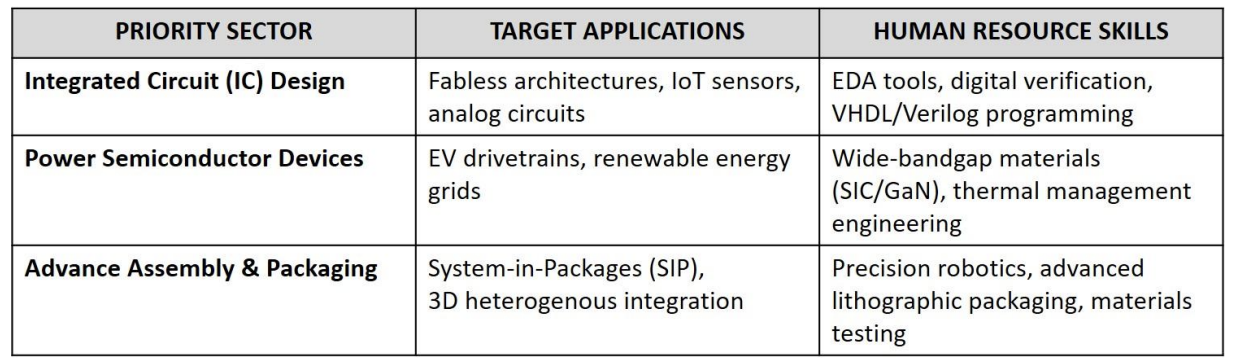
Strategic Action 4: International Knowledge Transfers and Geopolitical Alignment
To accelerate its technological timeline, Thailand must aggressively pursue international co-design partnerships. The 2026 MHESI collaboration with Arizona State University (ASU) serves as an effective blueprint for this strategy14. This initiative must expand into a dual-track framework:
- A Broad Train-the-Trainer Architecture: Sending Thai university professors and researchers abroad to leading international institutes for deep pedagogical and technical immersion. Returning faculty can then replicate modern semiconductor curricula locally15.
- Targeted Doctoral Fellowships: Creating fully funded overseas PhD fellowships in IC Design and Materials Science, structured with strict contractual commitments requiring recipients to return to Thailand to seed local university faculties and domestic R&D startups16.
4. Building an Ecosystem for R&D and Manufacturing Hub Retention
A highly skilled workforce cannot thrive in an industrial vacuum. To prevent capital flight and domestic brain drain, Thailand must build a highly supportive surrounding ecosystem.
Cluster Development and Financial Concessions
The Board of Investment (BOI) and other relevant government agencies must collaborate with MHESI to anchor advanced design facilities within the Eastern Economic Corridor (EEC). The government should provide aggressive, non-tax incentives alongside traditional tax holidays. These incentives should include R&D cash grants, matching funds for private corporate training tracks, and immediate tariff exemptions on imported scientific tooling and cleanroom components17.
Supply Chain Localization and Infrastructure Resilience
Developing an R&D hub requires excellent infrastructural reliability. The Thai government must ensure that its designated semiconductor clusters are supported by multi-source, highly stable power grids, adequate water supply and sustainable green energy options, which are increasingly demanded by global technology firms18. Additionally, the state should actively subsidize local chemical and precision-tooling suppliers to anchor a comprehensive domestic supply chain around these new manufacturing hubs.
Enhancing Multilateral G2B and Academic Partnerships
Lastly, to ensure that educational pipelines directly align with market realities, the Thai government must cultivate deep, collaborative relationships with foreign manufacturers operating within its borders to accurately audit their HRD needs. This initiative should materialize through a structured, multilateral framework linking Thai universities and vocational institutions with elite universities located in the home countries of these multinational corporations. By co-designing standardized curricula, practical training modules, and joint-degree programs tailored for both university-level engineers and vocational-level technicians, Thailand can rapidly absorb cutting-edge international pedagogical practices. This collaborative approach minimizes corporate onboarding friction, exposes local students to global engineering standards, and firmly anchors foreign tech giants within the domestic ecosystem.
Conclusion
Transitioning Thailand into a regional and global semiconductor manufacturing and R&D hub is an attainable goal, provided the state moves past legacy, assembly-line mindsets. The targeted cultivation of 80,000 technology professionals requires deliberate structural execution. By adopting Mainland China’s aggressive HRD policies, Taiwan’s deeply integrated academic-industry pipelines, South Korea’s targeted corporate tracks, and Japan’s agile reskilling consortia, Thailand can optimize its current public investments.
Through the implementation of educational sandboxes, centralized NSTC infrastructure, and strategic international partnerships, Thailand can move beyond simple assembly and testing. This coordinated push will establish the country as an indispensable, high-value node in the global semiconductor value chain.
Footnotes
- Office of National Higher Education Science Research and Innovation Policy Council (NXPO), “MHESI launches National Semiconductor Training Centers and Thai Semiconductor Industry Trade Association,” NXPO Policy Announcements, June 5, 2025.
- Thailand Board of Investment (BOI), “MHESI and BOI Join Forces to Advance Thailand’s Semiconductor Strategy Toward a High-Tech Economy,” Thailand.go.th, February 10, 2026.
- C. Y. Chang, The Evolution of Taiwan’s Semiconductor Ecosystem: A Study of Academic Industrial Symbiosis, Taipei: Academic Press, 2022, pp. 45–62.
- K. H. Kim, “Contract Departments and the Chaebol Pipeline: Evaluating South Korea’s Semiconductor Human Resource Framework,” Journal of Technology Education, vol. 34, no. 2, pp. 112–128, 2023.
- L. Wang, China’s Microelectronics Race: National Exemplary Schools and Technological Self Reliance, Beijing: Tsinghua University Press, 2024, pp. 89–104.
- H. Tanaka, “Consortia-Led Reskilling and the Revitalization of Japan’s Electronic Component Industry,” Tokyo Economic Review, vol. 71, no. 4, pp. 201–215, 2024.
- S. Khomfoi, “AI-Powered Semiconductor Ecosystem: Bridging Thailand’s Innovation Future,” National Science and Technology Development Agency Annual Conference (NAC2025), March 27, 2025.
- ibid., S. Khomfoi.
- ibid.
- ibid., Thailand Board of Investment (BOI).
- S. Sathitkunarat, “MHESI-NXPO unveils 2025 Achievements and 2026 Action Plan,” NXPO Executive Reports, March 2, 2026.
- ibid., S. Khomfoi.
- ibid., Thailand Board of Investment (BOI).
- ibid.
- ibid., Office of National Higher Education Science Research and Innovation Policy Council (NXPO).
- ibid.
- SEMI Southeast Asia, “Thailand’s Chip Ambition in Motion: Building a Competitive Hub in Southeast Asia,” SEMI Industry Blogs, October 30, 2025.
- Thailand Board of Investment (BOI), “Semiconductor and Advanced Electronics Investment Promotion Strategy 2026–2030,” BOI Publication PR3_2569EN, January 8, 2026.
Bibliography
Chang, C. Y. The Evolution of Taiwan’s Semiconductor Ecosystem: A Study of Academic-Industrial Symbiosis. Taipei: Academic Press, 2022.
Kim, K. H. “Contract Departments and the Chaebol Pipeline: Evaluating South Korea’s Semiconductor Human Resource Framework.” Journal of Technology Education, vol. 34, no. 2 (2023): 112–128.
Office of National Higher Education Science Research and Innovation Policy Council (NXPO). “MHESI launches National Semiconductor Training Centers and Thai Semiconductor Industry Trade Association.” NXPO Policy Announcements, June 5, 2025. https://www.nxpo.or.th/th/en/35265/.
Office of National Higher Education Science Research and Innovation Policy Council (NXPO). “MHESI-NXPO unveils 2025 Achievements and 2026 Action Plan.” NXPO Press Release, March 2, 2026. https://www.nxpo.or.th/th/en/43451/.
SEMI Southeast Asia. “Thailand’s Chip Ambition in Motion: Building a Competitive Hub in Southeast Asia.” SEMI Industry Blogs, October 30, 2025.
https://www.semi.org/sea/blogs/October-2025.
Tanaka, H. “Consortia-Led Reskilling and the Revitalization of Japan’s Electronic Component Industry.” Tokyo Economic Review, vol. 71, no. 4 (2024): 201–215.
Thailand Board of Investment (BOI). “MHESI and BOI Join Forces to Advance Thailand’s Semiconductor Strategy Toward a High-Tech Economy.” Thailand.go.th Focus, February 10, 2026. https://thailand.go.th/issue-focus-detail/MHESI-BOI-Semiconductor-Strategy.
Thailand Board of Investment (BOI). “Semiconductor and Advanced Electronics Investment Promotion Strategy 2026–2030.” BOI Publication PR3_2569EN, January 8, 2026. https://www.boi.go.th/upload/content/PR3_2569EN.pdf.
Wang, L. China’s Microelectronics Race: National Exemplary Schools and Technological Self Reliance. Beijing: Tsinghua University Press, 2024.

Darmp Sukontasap, Ph.D.
About Author
ON THIS PAGE
Darmp Sukontasap, Ph.D.
About Author
ON THIS PAGE


Thailand’s Strategic Integration into the Global Technology Supply Chain