
Home / Research & Analysis / Occasional Paper
December 2025
Analysis on the Sustainability of Military Capabilities of Thailand and Cambodia in 2025
Introduction
The latest round of military confrontation between Thailand and Cambodia started on 8 December 2025. Since then, the war-like situation has increasingly intensified along the border areas of the two countries, incurring substantial losses and expenses to both Thailand and Cambodia.
Question arises over the economics of the situation; specifically, how long can the government and military of the two neighboring countries afford this war, and how soon can the situation come to an end.
This occasional paper aims to analyze the economic and military reserves of the two countries, based on available public information, to provide an estimate on how much longer can the military of the two countries afford to sustain the existing war like situation.
Sustainability Metric
International and regional estimates of military sustainability, measured in days, highlight a stark contrast between Thailand’s strategic depth and Cambodia’s reliance on immediate, limited stockpiles.
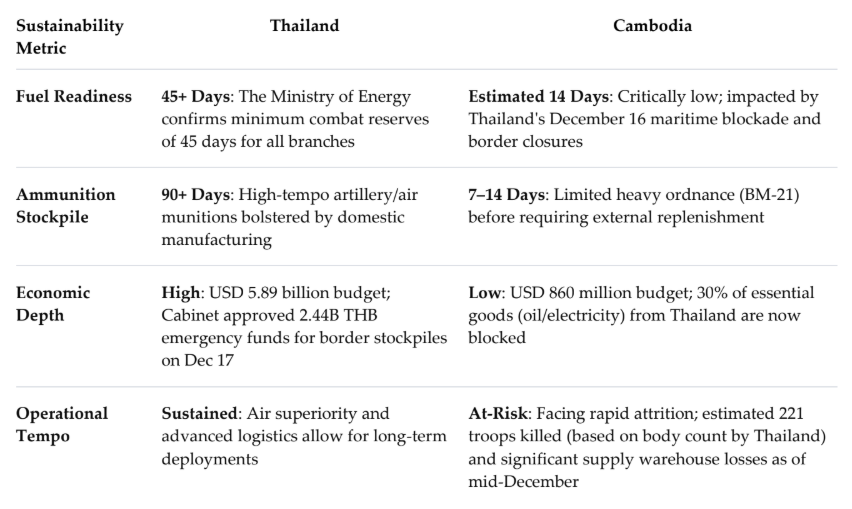
Thailand: Strategic Depth and 45-Day Minimum
- Fuel Readiness: The Thai Ministry of Energy confirmed in December 2025 that military fuel reserves are maintained at a minimum of 45 days specifically for combat operations.
- Ammunition Advantage: Thailand’s “well-funded” military (Ranked 25th globally) has domestic manufacturing capabilities for small arms and artillery shells, allowing it to sustain operations far beyond initial stockpiles.
- Logistics: The Royal Thai Army successfully destroyed major Cambodian arms and ammunition warehouses near the border on December 13, further extending Thailand’s relative sustainability by degrading the opponent’s immediate supply.
Cambodia: The "Sustainability Dilemma"
- Supply Depletion: International analysts (IISS) describe Cambodia as having “inadequate logistics” for prolonged war. High-intensity usage of BM-21 rockets and the modern GAM-102 anti-tank missiles—valued estimated at USD 112,000 per unit—is expected to deplete current front-line stocks within 15 to 20 days.
- Dependency on Imports: Cambodia relies on Thailand for 30% of its essential imports, including oil. Following the National Security Council’s December 16 resolution to block all fuel shipments to Cambodia, the country’s military sustainability is expected to drop significantly as internal reserves are diverted to civilian needs.
- Attrition: Estimates suggest that if the current intensity of fighting (8 December–present) continues, Cambodia’s heavy weapon stocks could reach critical levels within less than 30 days without direct intervention from international supporters like China.
- External Factors: What remains unclear is whether or not Cambodia is currently receiving external assistance in the form of financials, supplies, weapons and ammunition, military personnel, etc., all of which may have a positive impact on the sustainability of the Cambodian military operations.
Key Strategic Drivers in December 2025
- The Blockade Effect: Following a National Security Council (NSC) resolution on December 16, 2025, Thailand suspended all fuel and strategic goods exports to Cambodia, severely shortening Cambodia’s military “clock”.
- Logistical Asymmetry: International analysts (IISS) describe Cambodia as having “inadequate logistics” for a war lasting more than one month without external intervention, whereas Thailand is ranked 25th globally for its well funded, advanced military machine.
- Current Casualties: As of December 18, 2025, the conflict has resulted in at least 21 Thai fatalities, with reports suggesting much higher losses on the Cambodian side, further straining their immediate manpower and equipment sustainability.
Conclusion
Based on the above data and analysis, it can be assumed that, without external interference in the form of assistance to either of the parties, the military confrontation between Thailand and Cambodia would come to an end within the next 20 days, or before the end of January 2026. Whether or not the war situation would continue in other shapes or forms, such as guerrilla warfare or state sponsored terrorism or others, remains highly uncertain.
Disclaimer
The above analysis is based on the available public information on the economics of the military capabilities of Thailand and Cambodia. It does not take into account the military strategies and operational tactics of the armed forces of the two countries.
Reference
International Military & Intelligence Briefings
International Institute for Strategic Studies (IISS). (2025). The Military Balance 2025. London: IISS.
Global Firepower. (2025, January). 2025 Thailand Military Strength Ranking. Retrieved from GlobalFirepower.com.
SpecialEurasia Intelligence. (2025, July 24). Intelligence Briefing: Thailand-Cambodia Military Escalation and Logistical Assessments. SpecialEurasia.
Government Statements & Press Releases
Ministry of Foreign Affairs of Thailand. (2025, July 24). Statement on Thailand-Cambodia Situation: Sovereignty Violations and Military Readiness. mfa.go.th.
Ministry of Energy, Thailand. (2025, December 16). Weekly Energy News Report: Fuel Supplies ‘More Than Sufficient’ During Border Crisis. Facebook/DEDE.
Government of Thailand. (2025, December 8). Statement of Minister of Defence concerning Thailand Cambodia Border Clash. thailand.go.th.
Media & Economic Analysis
Reuters. (2025, December 8). Factbox: How do Cambodia and Thailand’s militaries compare? Reuters.com.
The Nation Thailand. (2025, June 7). Thailand and Cambodia’s military strength compared in 2025: Personnel and Equipment Inventory. NationThailand.com.
Quantum Commodity Intelligence (QC Intel). (2025, December 13). Thailand extends oil export ban to Cambodia amid border conflict. qcintel.com.
AMRO (ASEAN+3 Macroeconomic Research Office). (2025, November 17). Analytical Note: Assessment of the Economic Impact of Cambodia-Thailand Border Conflicts. amro-asia.org.
ON THIS PAGE
Further Reading
- Analysis