Home / Research & Analysis / Occasional Paper
No. 3/2025 · December 2025
Cambodia’s Transformation from a Recipient of Grants to a Debtor Nation
Introduction
In 2015, the World Bank officially reclassified Cambodia from a “low-income” country to a “lower middle-income” economy. The new classification was a major milestone for the country, but it has also led donors to reduce their financial grants to Cambodia. Such decline has forced the Kingdom to shift towards concessional loans (low-interest loans), as well as to seek “new sources of income” to fill the growing gap in its national budget. By 2011, the government has formally institutionalized “Debt Management Strategies.”
Such strategies do achieve some notable success. And, by 2019, Cambodia’s external debt was at a low of 20.8% of GDP. In 2020, however, the COVID-19 pandemic was the key catalyst that turned “borrowing for the budget” into a standard necessity. This is also the period where the Cambodian government seemed to be more committed to such “new sources of income.”1 By 2020, external debt has gone up to 25.2% of GDP, or to an amount of USD 8.81 billion. From this amount, roughly 70% was bilateral and the remaining 30% was from international institutions.
Present Day Fiscal Management
In 2025–2026, Cambodia’s financial landscape is increasingly defined by a heavy reliance on external borrowing to sustain its national budget.2 As traditional “grant-based” aid from Western nations continue to decline, Cambodia finds it increasingly necessary to pivot toward concessional loans from bilateral and multilateral partners.3
For the fiscal year 2026, the Cambodian government has announced a total spending plan of approximately USD 10.2 billion, with a projected borrowing requirement of USD 3.1 billion to cover its deficit and fund public investment projects.4
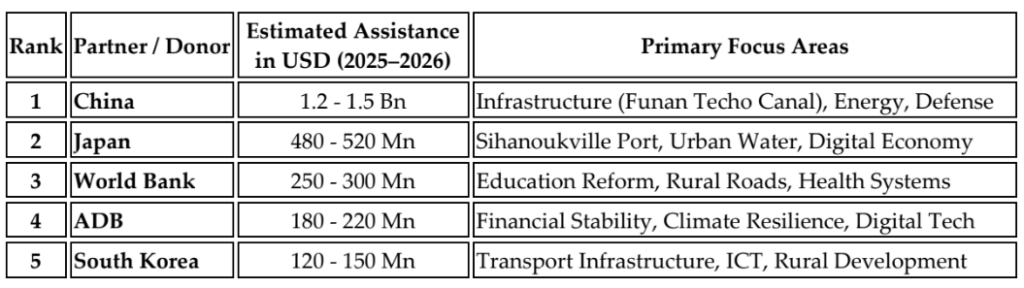
Top 5 Estimated Financial Partners of Cambodia (2025–2026)
The following list includes both bilateral donors and multilateral lending institutions, which now provide the bulk of Cambodia’s development capital.
Key Financial Shifts in 2025–2026
- The Borrowing Surge: To fund the 2026 budget, the government plans to borrow 2.25 billion Special Drawing Rights – SDR (approx.5 USD 3.1 billion), a 12.5% increase from 2025.6 This reflects a transition from “receiving aid” to “managing debt.
- The China Factor: China remains Cambodia’s largest creditor and primary source of development capital. In 2025, China began “backfilling” gaps left by Western donors, such as a USD 4 million emergency grant for demining and significant support for the controversial Funan Techo Canal project.7
- The Western Decline: Following the closure of USAID in mid-2025 and budget cuts in the EU, traditional Western ODA has shifted toward targeted “human rights” and “climate” grants rather than large-scale infrastructure. The U.S. contribution for 2025 is estimated at roughly USD 109 million, dropping it out of the top five financial contributors.
- Debt Composition: As of late 2025, Cambodia’s external debt stands at USD 12.54 billion.8 Roughly 61% of this is owed to bilateral partners (mostly China), while 39% is owed to multilateral banks (ADB and World Bank).9
Accordingly, independent analysts and the NGO Forum on Cambodia have raised alarms regarding the “worrying rate” of new borrowing.10 They caution that without stronger anti corruption oversight, these massive inflows risk enriching the ruling elite while burdening the next generation with unsustainable debt.11
Conclusion
The 2025–2026 financial landscape reveals a pivotal shift in Cambodia’s economic sovereignty, as the nation transitions from a recipient of financial grants to a state heavily leveraged by foreign debt. With a USD 10.2 billion spending plan necessitating USD 3.1 billion in new loans, the country is increasingly dependent on bilateral and multilateral creditors—most notably China, which now accounts for the lion’s share of both infrastructure investment and total external debt.
This pivot toward the “China Factor” coincides with a sharp decline in Western influence, marked by the closure of USAID and a retreat of traditional grant-based assistance, leaving Cambodia with fewer diversified sources of capital.
Ultimately, these developments signal a precarious future for Cambodia’s fiscal health. The concentration of 61% of external debt within bilateral partnerships, paired with a 12.5% surge in borrowing, has sparked urgent warnings from watchers of sovereign credit risks regarding debt sustainability.
The on-going border conflict with Thailand is not much of a help either, as it has led to massive unplanned spending by the government, foreign investment and foreign tourists flight, disruption of revenue flow from “new sources of income,” and loss of jobs by over 1.2 million Cambodian workers in Thailand.12
Therefore, what Cambodia is now facing is a myriad of challenges that will become increasingly prominent in 2026. This makes it uncertain whether the planned USD 3.1 billion will now be enough to help sustain the country’s economy and development plan.
On top of all this, is the endemic problem of corruption and cronyism. Without robust budget spending oversight and anti-corruption measures, there is a significant risk that, whatever large capital inflows that enter the country, will primarily benefit the ruling elite and their high profile infrastructure projects. The population and future generations, on the other hand, will be left to grapple with an accumulating debt burden that may soon outpace the country’s actual economic growth.
Footnotes
- Global Initiative Against Transnational Organized Crime. Cyber-Scam Clusters: The New Frontier of Transnational Crime in Southeast Asia. Geneva: GI-TOC, 2023. (According to GI-TOC, the year 2017 marked a critical turning point when large-scale investment in the Sihanoukville SEZ, as well as provinces bordering Thailand, provided a physical “shield” for illicit online gambling operations to establish a permanent footprint.)
- World Bank, Cambodia Economic Update: Navigating Global Headwinds and Domestic Debt (Washington, DC: World Bank Group, 2025), 4.
- Asian Development Bank, Cambodia: Country Operations Business Plan (2025–2027) (Manila: ADB Publishing, 2025), 12–15.
- Kingdom of Cambodia, Ministry of Economy and Finance, The Law on Financial Management for the Year 2026 (Phnom Penh: Royal Government of Cambodia, 2025).
- Special Drawing Rights (SDR) conversion based on IMF exchange rates as of December 2025.
- Kingdom of Cambodia, Ministry of Economy and Finance, Public Debt Statistical Bulletin, Vol. 20 (Phnom Penh: General Department of International Cooperation and Debt Management, 2025).
- “China Pledges Continued Support for Funan Techo Canal and Demining Initiatives,” Khmer Times, August 14, 2025.
- Kingdom of Cambodia, Ministry of Economy and Finance, Cambodia’s External Debt Status Report (Q4 2025) (Phnom Penh: MEF, 2025).
- International Monetary Fund (IMF), 2025 Article IV Consultation—Staff Report for Cambodia (Washington, DC: IMF, 2025), 18–21.
- NGO Forum on Cambodia, Transparency in Public Debt: A Review of the 2026 Borrowing Plan (Phnom Penh: Local Civil Society Analysis, 2025).
- Human Rights Watch, The Hun Dynasty: Consolidating Power Through Criminal Patronage (New York: Human Rights Watch, 2025), 34–36.
- Economic and Social Externalities of Interstate Conflict: A Study of the Economic and Social Fallout from the Thailand-Cambodia Conflict in 2025, Institute for Strategic Policy, Bangkok (December 2025).
Bibliography
Al Jazeera Investigative Unit. “The Billion Dollar Scam: Inside the Cambodian Compounds.” Al Jazeera English, June 15, 2025. [Digital Documentary/Report].
Amnesty International. Profit and Pain: State Complicity in Cambodia’s Forced Labor Compounds. London: Amnesty International Secretariat, 2025.
Asian Development Bank. Cambodia: Country Operations Business Plan (2025–2027). Manila: ADB Publishing, 2025.
Financial Action Task Force (FATF). Jurisdictions under Increased Monitoring: Cambodia Update on Anti Money Laundering Measures. Paris: FATF Secretariat, 2025.
Human Rights Watch. The Hun Dynasty: Consolidating Power Through Criminal Patronage. New York: Human Rights Watch, 2025.
Kingdom of Cambodia. Ministry of Economy and Finance. The Law on Financial Management for the Year 2026. Phnom Penh: Royal Government of Cambodia, 2025.
Netherlands Ministry of Foreign Affairs. “Policy Note: Trade, Security, and Migration—A New Direction for Dutch Development Cooperation.” The Hague: Government of the Netherlands, February 2025.
NGO Forum on Cambodia. Transparency in Public Debt: A Review of the 2026 Borrowing Plan. Phnom Penh: Local Civil Society Analysis, 2025.
OECD. Official Development Assistance (ODA) 2024–2025 Preliminary Estimates: The Great Contraction. Paris: OECD iLibrary, 2025.
The Straits Times. “The ASEAN Prize Controversy: Diplomatic Ties and Political Implications in Kuala Lumpur.” The Straits Times, November 12, 2025.
United Nations Office on Drugs and Crime (UNODC). Transnational Organized Crime in Southeast Asia: Evolution, Dynamics and Responses. Bangkok: UNODC Regional Office for Southeast Asia and the Pacific, 2024.
United States Department of State. Trafficking in Persons (TIP) Report: Cambodia (Tier 3 Designation). Washington, DC: Office to Monitor and Combat Trafficking in Persons, 2025.
United States Department of the Treasury. “Office of Foreign Assets Control (OFAC) Sanctions List: Designations on the Huione Group and Associated Entities.” Washington, DC: US Department of the Treasury, 2025.
United States Institute of Peace (USIP). The Globalization of Scamming: How Southeast Asia’s Cyber Fraud Industry Operates. Washington, DC: USIP Research Press, 2024.
World Bank. Cambodia Economic Update: Navigating Global Headwinds and Domestic Debt. Washington, DC: World Bank Group, 2025.
ON THIS PAGE
Further Reading
- Analysis