
No. 2/2026 · 25 June 2026
Thailand’s Strategic Integration into the Global Technology Supply Chain
Abstract
1. Introduction and Core Objective
The global technological landscape is undergoing a profound structural realignment driven by geopolitical fragmentation, supply chain diversification, and the rapid deployment of artificial intelligence. In this macroeconomic climate, Thailand stands at a critical historical juncture. The core objective of this policy framework is to position Thailand as an integral and indispensable component of the future global technology supply chain, specifically within the critical verticals of advanced microchips, semiconductors, AI technologies, and data center infrastructures.
Modern economic resilience dictates that a nation cannot merely remain a consumer or passive assembler of electronic components; instead, it must actively command high-value intellectual property and production capabilities to protect its sovereign national interests.
Historically, Thailand’s electronics sector has been dominated by low-to-medium value-added Outsourced Assembly and Testing (OSAT) and Printed Circuit Board (PCB) fabrication. To leapfrog from a middle-income trap into a high-income, knowledge-based society, Thailand must orchestrate a coordinated transition toward upstream design and specialized chip manufacturing. This document sets forward the economic rationale, sector-specific targets, and governance mechanisms required to construct a competitive technological ecosystem.
2. The Strategic Dichotomy: General-Purpose vs. Specialized Paradigms
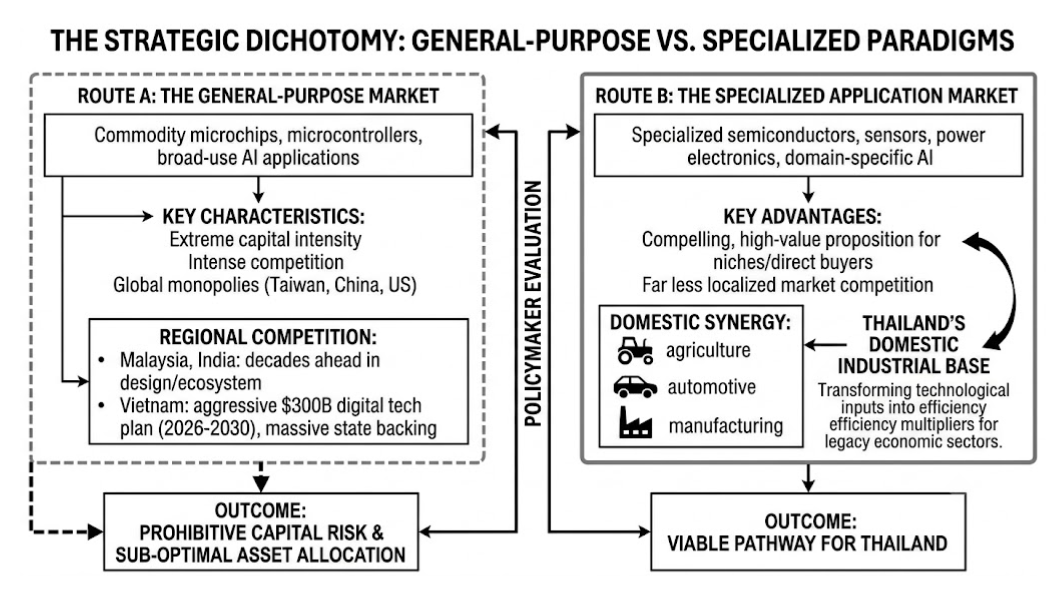
To realize the overarching objective, policymakers must evaluate two mutually exclusive developmental pathways:
Route B:The Specialized Application Market. Alternatively, Thailand can focus exclusively on specialized semiconductors, sensors, power electronics, and domain-specific AI applications. This pathway presents a compelling, high-value proposition for niche global markets and direct buyers. Specialized semiconductors—such as silicon carbide (SiC) and gallium nitride (GaN) power devices, analog sensors, and photonics—face far less localized market competition. More importantly, this route leverages Thailand’s domestic industrial base, transforming technological inputs into direct efficiency multipliers for legacy economic sectors.
Figure 1.
3. Socio-Economic Benefits and the Multiplier Effect
Adopting the specialized technological pathway (Route B) yields significant, structural economic advantages. First, it ensures that Thailand is deeply integrated into the global technology supply chain via proprietary, high-moat components that cannot easily be substituted during geopolitical shocks. Second, the value creation across existing domestic fields is virtually limitless. Rather than relying on imported, unoptimized technology, Thailand will generate customized solutions that directly elevate national competitiveness.
From a macroeconomic perspective, this strategy triggers a comprehensive multiplier effect on income generation and domestic product quality, elevating Thai exports to comply with stringent global standards. By prioritizing R&D and advanced manufacturing, the state drives a structural shift toward a knowledge-based society. Empirical evidence demonstrates that a 1% increase in specialized semiconductor R&D spending correlates with broad-based gains in multi-factor productivity across interconnected industries. Furthermore, this clear strategic commitment enhances investment efficiency, upgrades workforce competency, and acts as a powerful catalyst to attract premium Foreign Direct Investment (FDI) from global tech leaders seeking resilient supply partners.
In addition, from a pragmatic standpoint, for a country to pursue the specialized application pathway (Route B), the ambition would inherently forces the country to rapidly cultivate a new generation of highly skilled and technologically proficient workforce and to invest in the acquisition of sophisticated technical infrastructure for the country. Therefore, by anchoring the national strategy on these high-complexity foundations from the outset, Thailand effectively future-proofs its
industrial ecosystem. This foundational mastery grants the country the unique structural agility to pivot seamlessly between high-margin niche applications and large-scale commodity production (Route A) as global market dynamics dictate. Ultimately, building for the highest tier of technology ensures that Thailand commands the baseline capabilities to excel across the entire value chain.
4. Strategic Synergies with Primary Domestic Industries
The primary merit of the specialized strategy lies in its tailored alignment with the core industries that Thailand already possesses a comparative advantage in:
- Automotive: Thailand is a premier global automotive assembly hub, particularly within the transitioning Electric Vehicle (EV) market. Developing domestic capabilities in power semiconductors, battery management microchips, and autonomous driving sensors directly secures the local automotive supply chain against international vulnerabilities.
- Manufacturing: Integrating domain-specific AI, power electronics, and advanced sensors will transform Thailand from a low-value component assembler into a high-margin, precision-driven manufacturing hub. Upgrading legacy factory floors into smart facilities will optimize operational efficiency and elevate domestic production quality to meet stringent global standards.
- Food and Agriculture: By utilizing specialized Internet of Things (IoT) sensors and localized AI applications, Thailand can revolutionize its agricultural sector through high-precision farming, automated yield forecasting, and intelligent supply chains, significantly boosting income and security for local farmers.
- Energy: Modern smart grids and renewable energy systems require complex analog chips, smart inverters, and predictive AI workloads to manage structural load changes, aligning with national decarbonization mandates.
- Medical and Pharmaceuticals: Specialized biochemical sensors and localized machine learning algorithms can rapidly accelerate domestic pharmaceutical
synthesis, medical device development, and telehealth diagnostics, establishing Thailand as a premium healthcare hub.
5. Project Implementation and Institutional Governance
Translating this conceptual blueprint into execution requires an agile, highly disciplined governance framework structured around five core pillars:
1. Leadership and Ownerships: Executing this hyper-focused technological roadmap requires centralized, high-level leadership to eliminate institutional friction and maintain cross-sectoral policy consistency. Clear administrative ownership must be vested in a dedicated governing body capable of orchestrating national strategy, assigning strict accountability, and driving swift operational execution across both public and private stakeholders. Without this authoritative steering mechanism, resource allocation risks fragmentation, stalling Thailand’s strategic integration into the global value network.
2. Public-Private-Knowledge (PPK) Partnerships: Traditional state-led or market-isolated initiatives are insufficient. Implementation must rely on structured PPK partnerships that unify state funding, private enterprise commercialization, and academic research capabilities into cohesive R&D consortia.
3. Overcoming Regulatory Hurdles through “Sandboxes”: High-tech innovation is frequently stymied by rigid regulatory architectures. The state must establish specialized regulatory and geographical “sandboxes” where cross-border data flows, intellectual property registration, and advanced pilot manufacturing can operate under highly flexible legal exemptions. This must be reinforced by a highly flexible, target-oriented resource allocation model.
4. Exceptional Marketing, Sales, and Communication: To position Thailand within the global value web, the state must employ a sophisticated, proactive business development strategy to market its specialized capabilities to multinational corporations. Concurrently, a transparent communication strategy must be deployed domestically to build widespread public support, demonstrating clear societal alignment.
5. Advancement of the National Interest: The ultimate benchmark of success is the long-term protection and advancement of national welfare. This requires ensuring the technological ecosystem can withstand external economic threats, reducing domestic socio-economic disparities by supporting small scale farmers, small business owners, producers and entrepreneurs, minimizing institutional conflicts, and maintaining a fair, transparent justice system that rigidly protects intellectual property rights and the way of life of big and small players alike.
6. Conclusion
Thailand cannot afford a generic, unfocused approach to high technology. By rejecting the commoditized, general-purpose route in favor of a hyper-focused, specialized application paradigm, Thailand can maximize its existing industrial strengths, safely circumvent insurmountable competitive barriers, and foster a highly productive, knowledge-based economy. Strategic focus, strong leadership and policy commitment from all government and private stakeholders, operational speed, and robust institutional governance will determine whether Thailand successfully commands a premium position in the global technological order.
References
Deloitte Global Technology Insights. (2025). Specialized Microchips and the Shift Toward Vertical Supply Chain Integration. Deloitte Insights Network.
ISEAS – Yusof Ishak Institute. (2025). Thailand’s New Semiconductor Strategy: Ambitious but Challenging. Flcrum Analysis, Regional Economic Frameworks.
Ministry of Foreign Affairs, Thailand (ISC/MFA). (2024). Strategic Industrial Policy and National Security in the Semiconductor Era. International Studies Center Report.
Ministry of Information and Communications, Socialist Republic of Vietnam. (2026). Digital Technology Industry Development Programme for 2026-2030. Hanoi: State Planning Directive.
SEMI Southeast Asia. (2026). Thailand at the Crossroads: Connecting Global Semiconductor Value Chains. Singapore: SEMI Industry Report.
Thailand Board of Investment (BOI). (2026). Draft National Semiconductor and Advanced Electronics Strategy (2026–2050). Bangkok: Ministry of Finance.
World Bank Group. (2026). Forging Southeast Asia’s Technological Future: Innovation, Governance, and Human Capital. Washington, D.C.: World Bank Publications.
World Semiconductor Trade Statistics (WSTS). (2026). Global Semiconductor Market Forecast and Regional Dynamics. Dynamic Industry Outlook.
ON THIS PAGE
- Abstract
- 1. Introduction and Core Objective
- 2. The Strategic Dichotomy: General-Purpose vs. Specialized Paradigms
- 3. Socio-Economic Benefits and the Multiplier Effect
- 4. Strategic Synergies with Primary Domestic Industries
- 5. Project Implementation and Institutional Governance
- 6. Conclusion
- Reference
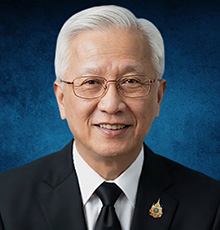
Prof. Kanok Wongtrangan, Ph.D.
About Author
ON THIS PAGE
- Abstract
- 1. Introduction and Core Objective
- 2. The Strategic Dichotomy: General-Purpose vs. Specialized Paradigms
- 3. Socio-Economic Benefits and the Multiplier Effect
- 4. Strategic Synergies with Primary Domestic Industries
- 5. Project Implementation and Institutional Governance
- 6. Conclusion
- Reference
Further Reading
- Analysis