
Home / Research & Analysis / Policy Brief
No. 3/2026 · 1 May 2026
The ASEAN Power Grid (APG): Transitioning Bilateral Projects to a Multilateral Regional Energy Market
Abstract
The ASEAN Power Grid (APG) represents a foundational initiative for regional integration among the ten ASEAN member states. Historically characterized by bilateral agreements, the APG is currently undergoing a strategic pivot toward a “Green Grid” model. This paper examines the current operational status of the APG as of April 2026, the institutional and regulatory hurdles to full integration, and the specific strategic role of Thailand as a regional energy hub, through intra-regional and extra-regional support.
I. Introduction
The ASEAN Power Grid (APG) is a flagship initiative designed to interconnect the national electricity grids of all 10 ASEAN member states. Originally conceived under the ASEAN Vision 2020, its mandate has expanded beyond simple energy security to include the facilitation of surplus power trade and the acceleration of the regional renewable energy transition. By linking diverse energy landscapes—such as the hydropower-rich Mekong sub-region with high-demand urban centers like Singapore—the APG seeks to create a resilient, cost-effective energy market.
II. Current Operational Status
As of early 2026, the APG has transitioned from a purely bilateral model to a “multilateral pilot” phase, with the long-term goal of a fully integrated market targeted for 2040–2045.
- Key Pilot Projects
- LTMS-PIP (Lao PDR-Thailand-Malaysia-Singapore): Recognized as the most successful pilot, it facilitates the trade of Laotian hydropower to Singapore. In 2026, Singapore has doubled its import capacity to 200 MW.
- BIMP-PIP (Brunei-Indonesia-Malaysia-Philippines): This eastern sub region initiative finalized feasibility studies in late 2025. Under the 2026 Philippines ASEAN Chairmanship, high-level talks are underway to initiate physical interconnections between the Philippines and Malaysia.
- Nusantara Grid (Indonesia): A domestic precursor project (2025–2026) aimed at connecting the Indonesian archipelago to ensure the nation is “export-ready” for regional links.
- Quantitative Milestones ASEAN currently maintains approximately 7.7 GW of cross-border interconnection capacity across 9 priority projects. The “Green Grid” framework aims to increase the renewable energy mix from under 30% to over 70% by 2045.
III. Institutional and Regulatory Frameworks
The ASEAN Plan of Action for Energy Cooperation (APAEC) 2026–2030, adopted at the 43rd ASEAN Ministers on Energy Meeting (AMEM) in October 2025, serves as the primary regional blueprint for energy policy within Southeast Asia. The central theme of the 2026-2030 cycle is: “Advancing Regional Cooperation in Ensuring Energy Security and Accelerating Decarbonisation for a Just and Inclusive Energy Transition.”
Compared to previous cycles, the 2026–2030 framework significantly raises the bar for regional energy transformation:
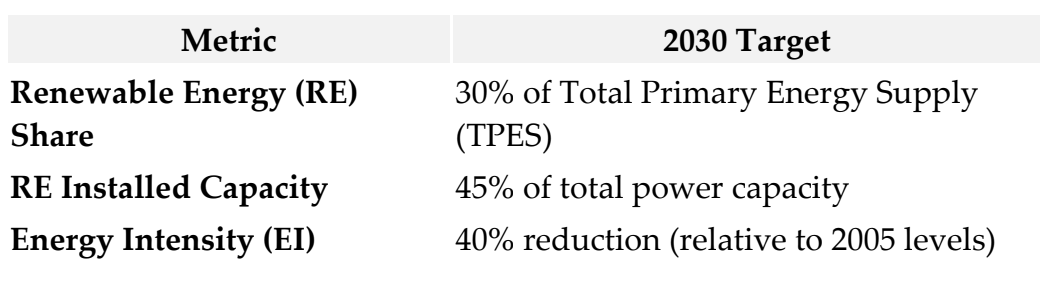
The framework emphasizes three pillars:
- Regional Connectivity: Strengthening the physical and regulatory infrastructure needed for a unified energy market.
- Resilience & Transition: Balancing the immediate need for reliable energy supply with the long-term goal of decarbonization.
- Inclusivity: Ensuring the transition supports economic growth without compromising energy affordability or accessibility for developing member states.
Significant new emphasis has been placed on emerging low-carbon solutions, including hydrogen, ammonia fuel, and Carbon Capture, Utilization, and Storage (CCUS), as well as the establishment of the ASEAN School of Regulation (ASR) to harmonize energy standards across the bloc.
In order to ensure the success of such goals, the 2026-2030 framework adopts a comprehensive approach to energy transition by structuring the work plan into seven specialized domains, namely:
- ASEAN Power Grid (APG): Focused on enhancing cross-border electricity trade and regional interconnectivity via submarine cables and overland links.
- Trans-ASEAN Gas Pipeline (TAGP): Modernizing gas infrastructure to support energy security and integrating gas into decarbonization pathways (e.g., as a transition fuel).
- Clean Coal Transformation (CCTR): Transitioning from traditional coal use toward responsible management, emission reduction technologies, and carbon capture.
- Energy Efficiency & Conservation (EE&C): Accelerating intensity reductions in high-impact sectors like transport and industry through harmonized standards and digital energy management.
- Renewable Energy (RE): Scaling up deployment and improving grid flexibility to accommodate intermittent sources like solar and wind.
- Regional Energy Policy and Planning (REPP): Using data-driven modeling and the ASEAN Energy Outlook to ensure policy coherence across member states.
- Civilian Nuclear Energy (CNE): Building regional capacity and knowledge-sharing for small modular reactors (SMRs) and safety frameworks.
The APAEC 2026–2030 is, thus far, considered to be the most aggressive, inclusive and forward-looking plan for the APG.
IV. Challenges and Obstacles
Despite the seemingly strong forward momentum, several “voltage drops” still impede the progress of APG. These challenges include:
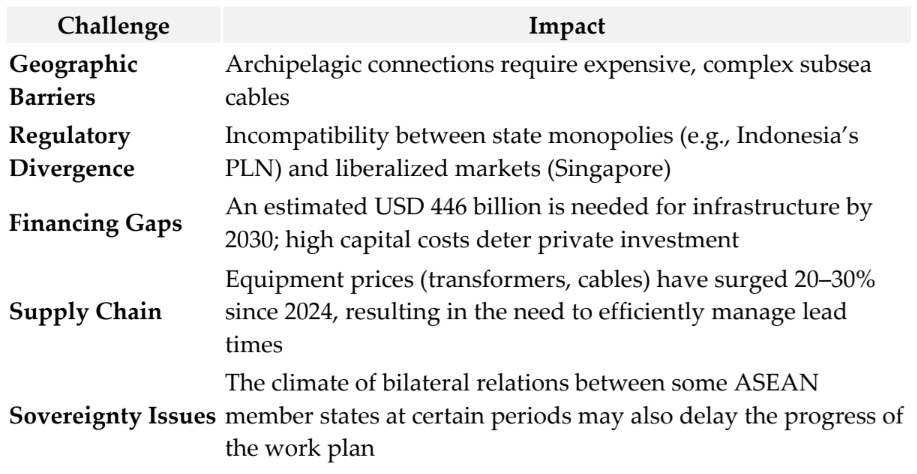
V. The Strategic Role of Thailand: The "Power Wheeling" Hub
Through the years, Thailand has grown from a “passive transit country” to an increasingly significant “strategic clearinghouse” for energy within a truly inclusive “regional” framework.
- Technical and Market Leadership: Thailand’s grid serves as the “spine” for the LTMS-PIP, allowing power to bypass bilateral constraints. To support this, the Energy Regulatory Commission (ERC) finalized a Third Party Access (TPA) Code, allowing non-state producers to use the state owned grid (EGAT) for a predictable “Postage Stamp Rate” fee.
- Energy Security and Green Investment: Thailand positions its grid as a “Virtual Battery,” using its capacity to stabilize variable renewable energy (VRE) across the region. Furthermore, a 2,000 MW “Green Quota” was approved to allow data centers and semiconductor manufacturers to procure green energy directly, supported by ISSB-aligned traceability for Renewable Energy Certificates (RECs).
VI. The Strategic Role of ASEAN Dialogue Partners
ASEAN Dialogue Partners, specifically the European Union (EU) and East Asian “Plus Three” countries—China, Japan, and South Korea—are central to the APG’s evolution from a series of bilateral links into a sophisticated, multilateral regional market. As of early 2026, their roles have shifted from being mere technology suppliers to becoming strategic architects of the regional grid.
Their substantial contributions include:
- Financial Leadership and Risk Mitigation: The “Plus Three” partners provide substantial capital and financial mechanisms required to overcome the USD 446 billion financing gap identified in recent energy outlooks.
- Japan’s AZEC Initiative: On 15 April 2026, Japan announced a USD 10 billion financial package through the Asia Zero Emission Community (AZEC) framework. This funding specifically targets cross-border transmission infrastructure and “resilient supply chains” to mitigate the impact of rising equipment costs and geopolitical instability.
- Multilateral De-risking: Dialogue partners work through the ASEAN Power Grid Financing Initiative (APGF), launched in late 2025 by the World Bank and ADB with heavy backing from regional partners. This initiative helps de-risk high-cost subsea cable projects, such as those in the BIMP-PIP (Brunei-Indonesia-Malaysia-Philippines) cluster.
Technological Innovation for “Green Grid” Integration
To achieve the goal of a 70% renewable energy mix by 2045, ASEAN requires advanced grid-balancing technologies where the Plus Three countries lead globally.
- China (CAFTA 3.0): Under the ASEAN-China Free Trade Area (ACFTA) 3.0 Upgrade Protocol signed in October 2025, a new “Green Economy” pillar focuses on the transfer of smart grid technology and high-voltage direct current (HVDC) systems. China is currently the largest provider of renewable energy equipment for the region’s new “Green Quotas”.
- South Korea’s Innovation Hubs: South Korea leverages its Knowledge Sharing Program (KSP) to help ASEAN member states integrate Energy Storage Systems (ESS) and Small Modular Reactors (SMRs). These technologies are essential for stabilizing the “Variable Renewable Energy” (VRE) that will flow through Thailand’s hub.
Harmonization of Regulatory “Soft Infrastructure”
The technical success of the APG depends on the harmonization of legal codes and “Wheeling Charges.”
- Capacity Building: Japan and South Korea provide critical support to the ASEAN School of Regulation (ASR). These programs train ASEAN regulators on “Third-Party Access” (TPA) codes, using the East Asian experience in power market liberalization as a model.
- Standards Alignment: Through the ASEAN-Plus-Three Energy Cooperation framework, partners are assisting in the alignment of Renewable Energy Certificates (RECs) with international ISSB standards, ensuring that “green” power traded across borders is verifiable for global investors.
Strategic Geopolitics and Resilience
By participating in the APAEC 2026–2030 cycle, Dialogue Partners can help ASEAN navigate “geopolitical uncertainty” and “climate shocks.”
- Energy Security Spine: The Plus Three countries support Thailand’s role as the regional “clearinghouse.” * By investing in Thailand’s grid upgrades, they ensure a stable “spine” that connects the hydropower rich North (Mekong) with the high-demand South (Singapore), creating a collective energy buffer for the entire region.
The European Union’s Global Gateway: A Catalyst for Quality Infrastructure
While the “Plus Three” countries focus on regional technology and immediate capital, the EU’s Global Gateway Initiative provides a critical framework for “soft” and “hard” infrastructure that aligns with the APG’s long-term sustainability goals.
- Bridging the Financing Gap with Sustainable Investment: The Global Gateway aims to mobilize up to €300 billion in investments globally. In the context of the APG, this initiative targets the USD 446 billion financing gap by leveraging de-risking instruments and private capital for complex projects, such as the subsea cables required for the BIMP PIP cluster.
- Regulatory Harmonization and Standards: The EU’s experience with the European Network of Transmission System Operators (ENTSO-E) serves as a blueprint for ASEAN. Through the Global Gateway, the EU supports the ASEAN School of Regulation (ASR) to implement high level transparency, competitive bidding processes, and environmental, social, and governance (ESG) standards.
- Green Hydrogen and Storage: To reach the 70% renewable energy target by 2045, the Global Gateway facilitates the transfer of European expertise in long-duration energy storage and green hydrogen— technologies that complement Thailand’s role as a “Virtual Battery.”
VII. Conclusion and Future Outlook
Golden Opportunity for Creating Synergy (Updated)
The prospects for the APG are at their highest in two decades, driven by a unique convergence of internal leadership and diversified external support. While Thailand provides the physical “spine” and regulatory “clearinghouse” through its Third-Party Access (TPA) Code, the success of the grid now hinges on a “multi-partner” approach:
- The “Plus Three” (China, Japan, South Korea): Provide the immediate industrial capacity, smart grid hardware, and the USD 10 billion AZEC/POWERR Asia funding to stabilize the physical grid.
- The European Union (Global Gateway): Acts as a strategic stabilizer by ensuring that infrastructure is built to international quality standards. The Global Gateway accelerates the realization of the APG by promoting multilateral regulatory frameworks and sustainable financing models that prevent “debt-trap” scenarios and ensure long-term grid resilience.
The Strategic Path Forward
With the combined backing of the Plus Three’s technical prowess and the EU’s Global Gateway standards, the APAEC 2026-2030 transition is no longer just a regional ambition but a globally supported energy corridor. Thailand’s role as the “power wheeling hub” is reinforced by these partnerships, ensuring that the transiting “green” power is verifiable, bankable, and integrated into the global shift toward net-zero emissions.
The Imperative for Thai Leadership in the ASEAN Power Grid (APG)
Based on strategic documents and the regional landscape of 2026, the “Plus Three” countries—China, Japan, and South Korea—have formally and consistently committed to supporting Thailand’s role as the “Regional Clearinghouse” or “Power Wheeling Hub” for the APG. This commitment is anchored in three critical pillars of support:
Recognition of Multilateral Leadership
The Plus Three countries have transitioned from supporting bilateral deals to endorsing Thailand as a central multilateral transit hub through the Lao PDR-Thailand-Malaysia-Singapore Power Integration Project (LTMS-PIP).
- Historical Context: The 2022 launch of the LTMS-PIP marked the first time Thailand acted as a “wheeling” (transit) partner for a four-country multilateral trade.
- The 2025 Reaffirmation: In October 2025, at the 43rd ASEAN Ministers on Energy Meeting (AMEM+3), ministers officially commended the LTMS-PIP as the “cornerstone of the APG”.
- Endorsement of Feasibility: By highlighting Thailand’s grid as a “demonstrator of feasibility” for multidirectional trade, partners have effectively endorsed Thailand’s status as the region’s clearinghouse.
Strategic Financial Backing
Thailand’s hub role is now integrated into the financial aid frameworks of major Dialogue Partners:
- ASEAN Power Grid Financing Initiative (APGF): Launched in October 2025 with heavy backing from the ADB and Dialogue Partners, this initiative identifies Thailand as the “interconnection spine” required to make regional projects bankable.
- Japan’s POWERR Asia: As of early 2026, Japan has allocated portions of its USD 10 billion energy package specifically for technical upgrades to Thailand’s state-owned grid (EGAT). This ensures the grid can manage the increased frequency and voltage requirements of regional energy transit.
Institutional Support for “Soft Infrastructure”
Since early 2026, the Plus Three countries have been helping Thailand establish the “Gold Standard” for regional energy trade regulations:
Regulatory Harmonization: Experts from South Korea and Japan are working with Thailand’s Energy Regulatory Commission (ERC) to refine the Third-Party Access (TPA) Code and wheeling charge formulas.
Standard Setting: Partners have supported Thailand’s adoption of ISSB-aligned traceability for Renewable Energy Certificates (RECs). This ensures that “green” power transiting through Thailand meets the international audit standards required by global investors.
With the strong support of ASEAN members and key Dialogue Partners—including the European Union’s Global Gateway Initiative which provides additional ESG aligned financing and de-risking—the APG is poised to move beyond simple bilateral deals. Thailand is now positioned to serve as the reliable, transparent, and central “Power Wheeling Hub” essential for Southeast Asia’s energy transition and regional connectivity.
Reference
- AMRO Asia. (2026, March 24). Building the Energy Resilience ASEAN+3 Needs. AMRO Macroeconomic Reports.
- ASEAN Centre for Energy (ACE). (2025). ASEAN Investment Report 2024-2025: Transitioning to the Green Dollar.
- ASEAN Energy Regulators Network. (2026). Report on Wheeling Charge Structures and Regulatory Harmonization.
- ASEAN Secretariat. (2026). ASEAN Plan of Action for Energy Cooperation (APAEC) 2026-2030.
- ASEAN Secretariat. (2025, October). ASEAN-China Free Trade Area (ACFTA) 3.0 Upgrade Protocol: Focus on Green and Digital Economy.
- ASEAN Secretariat. (2025, October). ASEAN Plan of Action for Energy Cooperation (APAEC) 2026-2030: Phase I Implementation Framework.
- ASEAN Secretariat. (2025, October). Joint Media Statement: The 22nd ASEAN Ministers on Energy Meeting Plus Three (AMEM+3). Kuala Lumpur, Malaysia.
- Bao Chinh Phu. (2026, April 15). Japan Announces US$10 Billion Package to Strengthen Energy Supply in Asia. Official Government Portal (Viet Nam).
- CSIS: New Perspectives on Asia. (2026, March 30). Plugging into Reality: The ASEAN Power Grid Financing Initiative (APGF). Center for Strategic and International Studies.
- Energy Regulatory Commission (ERC) of Thailand. (2026). Third-Party Access (TPA) Code and Green Quota Framework.
- European Commission. (2021). Global Gateway: Joint Communication to the European Parliament, the Council, the European Economic and Social Committee, the Committee of the Regions and the European Investment Bank (JOIN/2021/30 final).
- European Commission. (2021, December 1). Global Gateway: Up to €300 billion for the European Union’s strategy to boost sustainable links around the world [Press release].
- European Commission, Directorate-General for International Partnerships. (2023, March 1). The Global Gateway: Overview and principles of sustainable connectivity.
- European Commission. (2024, April). EU-ASEAN Global Gateway Factsheet: Investing in a sustainable future.
- European Parliament. (2024). Global Gateway 2030: Scenarios and strategic foresight for EU infrastructure investment. EPRS Policy Foresight Unit.
- European Parliament, Committee on Development. (2023, February 24). Global Gateway: Strategic governance and implementation.
- Furness, M., & Keijzer, N. (2022). Europe’s Global Gateway: A new geostrategic framework for development policy? German Development Institute (DIE).
- Karjalainen, T. (2022). The EU’s Global Gateway: Building connectivity as a policy (FIIA Working Paper 127). Finnish Institute of International Affairs.
- Lao PDR-Thailand-Malaysia-Singapore (LTMS) Steering Committee. (2026). Phase 2.0 Operational Summary and Capacity Expansion.
- Mardell, J. (2021). Global Gateway: The European Union’s new connectivity strategy. Mercator Institute for China Studies (MERICS).
- Philippines ASEAN Chairmanship. (2026). Priority Economic Deliverables: The Enhanced APG and Submarine Power Cable Framework.
- Politics and Governance. (2023). Europe’s Global Gateway: A new instrument of geopolitics. Politics and Governance, 11(4), 223–234.
- Regional Energy Outlook. (2025). Financing the Green Grid: Investment Gaps and Supply Chain Inflation.
- Soufan Center. (2026, April 15). The Spillover Effects of Global Instability on Asia’s Energy Transition.
- Vajiram & Ravi. (2026, April 17). POWERR Asia Initiative: Japan’s $10 Billion Framework for Regional Energy Security.
- Tagliapietra, S. (2024). The European Union’s Global Gateway: An institutional and economic overview. The World Economy, 47(4), 1326–1335.
- Teevan, C., & Bilal, S. (2023). The Global Gateway at two: Implementing EU strategic ambitions. European Centre for Development Policy Management (ECDPM).
ON THIS PAGE
ON THIS PAGE
Further Reading
- Analysis